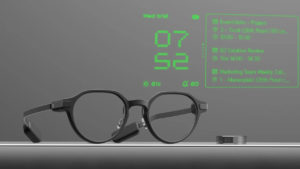
Even Realities, a three-year-old smart glasses startup based in Shenzhen, has raised $150 million in a pre-Series B round that values the company at $1 billion. Meituan led the round alongside returning backer Tencent, pushing the young hardware company into unicorn territory just as Meta and Snap ramp up their own competing lines of camera-equipped smart glasses.
The funding lands at a pivotal moment for the wearable computing category. Meta and Snap both released new smart glasses last month, intensifying a race among major tech players to put cameras and AI assistants directly onto people’s faces. Even Realities is positioning itself against that trend rather than following it.
A Different Bet: Displays Over Cameras
Founder and CEO Will Wang told TechCrunch that while competitors are building devices centered on camera capture and always-on AI, Even is betting on display-first glasses that project information directly into the wearer’s line of sight, without a camera at all.
That distinction sits at the center of the company’s pitch. Its flagship product, the G2, launched last November and skips the camera entirely. Instead, a heads-up display built into the frames feeds information to the wearer, controlled via a companion ring called the Even R1, which users tap and swipe to navigate.
Wang framed the camera-free design as central to Even’s approach to privacy, though he was clear it isn’t the whole picture. Smart glasses, he said, are likely the most personal computing device most people will ever wear, and because they’re worn on the face all day, comfort and privacy have to be designed into both hardware and software from the outset. Voice features like real-time translation transcribe audio into text rather than storing recordings, according to Wang, and user data is encrypted with infrastructure built to meet Europe’s strict privacy standards.
From Apple Engineers to a Fast-Growing Startup
Even Realities was founded in 2023 by a team of former Apple engineers. Wang previously worked on the Apple Watch and iPhone, and his co-founders bring backgrounds spanning broader tech and luxury eyewear, including a stint at Lindberg.
The company moved quickly. Its first product, the G1, launched in 2024, and Wang describes it as the lightest waveguide smart glasses on the market at the time. Even says it became the first company in the category to sell more than 10,000 units, surpassing its own internal target. Growth has followed a similar trajectory on the staffing side, with headcount expanding from roughly 30 to 40 employees in 2024 to somewhere between 300 and 400 today.
Before this round, Even had already attracted a notable list of Chinese investors, including Hillhouse, Sequoia China, and Northern Light Venture Capital.
Where the Optical Investment Goes
Wang said the company has put most of its resources into optics, meaning the display technology and overall optical performance, which he argues is what actually separates smart glasses from other consumer electronics categories.
According to Wang, a phone or watch display is a conventional OLED or LCD screen, but smart glasses are the first consumer category built around optical displays, a technology stack that requires designing the microchip, optics, and waveguide together rather than sourcing them separately. That integrated approach led to Even’s proprietary optical system, which the company calls Even HAO, short for Holistic Adaptive Optics. It combines the microchip, waveguide, and prescription lens support into a single end-to-end design rather than assembling components built in isolation.
Who Is Buying These Glasses, and Where
More than half of Even’s user base is in the United States, which the company also identifies as its fastest-growing market and the home of most of its developer community. Notably, Even doesn’t yet sell in China, despite manufacturing its devices there across multiple factories. Its current markets are the U.S., Japan, South Korea, the Middle East, and Europe. Wang said the company wants to be fully prepared before entering the Chinese market, given the scale of demand it expects there.
The company’s customer profile skews toward professionals. Wang said most buyers are male professionals between 30 and 50, and an internal survey found that roughly a third of users are company executives. Pricing reflects that positioning: the frames retail for $599 before tax, with prescription lenses or the companion ring adding another $200 to $300, bringing the average order to around $1,000. Despite sitting near the top of the market in terms of price, Wang said the company still moves meaningful volume and is profitable.
What It Means for the Smart Glasses Race
The $1 billion valuation signals that investors see room in the smart glasses market for more than just the handful of large platforms currently dominating headlines. Even’s bet against cameras, in particular, sets up a real product philosophy divide in the category: capture-and-analyse devices from Meta and Snap versus a display-and-privacy approach from Even.
Whether that distinction resonates with a broader consumer base beyond executives and professionals, or whether camera-equipped AI glasses ultimately win out on features and utility, will likely shape how the next round of competition in this space plays out.



[…] AI hardware startups are seeing similarly outsized rounds: Shenzhen-based smart glasses maker Even Realities recently hit a $1 billion valuation on a $150 million round led by Meituan and Tencent, a sign that investor appetite for AI hardware […]