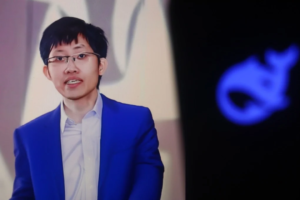
DeepSeek founder and CEO Liang Wenfeng has overtaken Anthropic’s Dario Amodei and OpenAI’s Greg Brockman to become the world’s richest founder among companies whose core business is building AI models, according to an updated calculation from the Bloomberg Billionaires Index. His net worth rose from about $16.7 billion to $36 billion, a jump Bloomberg attributes to DeepSeek’s first external fundraising round since the company launched in 2023.
Bloomberg updated the figure on July 13, translating into an overnight gain of roughly $19 billion for Liang. Combined, Amodei and Brockman’s fortunes still fall short of Liang’s total on their own: Amodei’s stake in Anthropic is worth around $8 billion following the company’s $65 billion raise in May at a $965 billion valuation, while Brockman’s OpenAI holdings are estimated at $25.5 billion, with OpenAI now valued at $852 billion.
An Unusual Ownership Structure
What separates Liang from his Silicon Valley counterparts isn’t the size of DeepSeek relative to OpenAI or Anthropic. It’s how much of the company he actually owns. DeepSeek’s $50 billion valuation is a fraction of OpenAI’s or Anthropic’s, yet Liang’s personal stake is worth more than the combined stakes of the founders of either company.
The June funding round raised $7.4 billion and valued DeepSeek at $50 billion, roughly five times its $10 billion valuation in April. Liang personally contributed $3 billion to the round. His ownership stake was diluted from an earlier estimate of around 84 percent down to approximately 78 percent, still an unusually concentrated position for a company at this scale.
The terms offered to outside investors help explain why. According to reporting on the round, investors were required to commit capital through a limited partnership structure that Liang personally controls, agree to a five-year lock-up period, and accept no voting rights. The one exception was China’s National Artificial Intelligence Industry Investment Fund, which received direct equity along with full voting rights. Every other investor in the round effectively bought in on trust alone. In the United States, building a company at a comparable valuation typically requires handing over significant equity and governance rights to venture capitalists and large tech partners, which is part of why founders at similarly valued American AI labs hold far smaller stakes than Liang does at DeepSeek.
Where the Wealth Comes From
Bloomberg’s ranking specifically covers founders of companies whose core business and majority of revenue come from AI models themselves. That excludes diversified technology conglomerates like Alibaba and Tencent, along with companies elsewhere in the AI supply chain, including chipmakers and data center operators.
That distinction matters for context. Chen Tianshi, the co-founder of Chinese chipmaker Cambricon Technologies, holds a stake reportedly worth close to $40 billion, which would surpass Liang’s fortune if hardware companies were included in the same comparison. Liang’s $36 billion still makes him the eighth-richest person in China overall, positioning him just behind Chen on the country’s broader wealth rankings.
The Product Behind the Valuation
DeepSeek’s rise in Liang’s personal wealth has tracked closely with the company’s rise in actual usage. The company currently accounts for roughly 16.3 percent of all token volume on OpenRouter, a share larger than any other single AI provider on the platform, including Google, Anthropic, and OpenAI. Its latest V4 model series is priced well below what Western frontier labs typically charge, a gap that has been pulling real enterprise workloads toward DeepSeek and away from more established competitors.
That trajectory began in January 2025, when DeepSeek released its R1 model. Analysts said it matched the performance of leading American AI systems while costing a fraction as much to develop and run, a claim that briefly wiped out an estimated $600 billion from Nvidia’s market capitalization as markets recalculated assumptions about how much computing power frontier AI actually requires. The release forced much of the rest of the industry to reconsider its own cost structures.
DeepSeek has continued shipping since then, most recently with its V4 model, which the company has marketed in part on its compatibility with chips made by Chinese tech giant Huawei, a detail that carries weight given continuing U.S. restrictions on advanced chip exports to China.
Early Career
Before entering AI, Liang built a career in quantitative finance. In 2015, he co-founded High-Flyer Capital Management with two former college classmates, applying machine learning techniques to trading. The firm grew into one of China’s largest and best-performing quantitative trading operations, peaking at $14 billion in assets under management in 2021. That business also gave Liang something that proved critical later: a substantial stockpile of powerful GPUs, purchased with trading profits even before the United States tightened export restrictions on advanced chips to China.
DeepSeek launched in 2023 as a spin-off from High-Flyer’s AI research arm, funded largely through the hedge fund’s own proceeds rather than traditional venture capital, which let the company develop its models with far less outside financial backing than most AI startups require.
Liang’s public profile has grown alongside the company’s. In 2025, he was named to Time’s list of the 100 Most Influential People in AI and to Fortune’s list of the Most Powerful People in Business.
What’s Next:
None of DeepSeek’s outside investors holds any real say over where the company goes next, a structure that stands in sharp contrast to how most frontier AI labs in the United States are financed and governed. For now, Liang’s fortune remains tied almost entirely to a single, closely held asset in one of the most competitive and fastest-moving sectors in global technology. Whether that concentration proves to be a long-term advantage or a long-term risk will likely become clearer as DeepSeek’s usage numbers and its next funding round come into view.