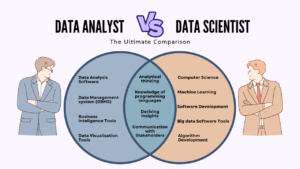
Anyone researching a move into data work eventually runs into the same fork in the road: data analytics or data science. The two fields sound similar, sit inside the same industry, and often get lumped together in job postings and course marketing. But they lead to different daily work, different skill demands, and different salary ceilings.
This comparison breaks down what each role actually involves, where they overlap, where they diverge, and how to figure out which path suits your background and goals.
Overview of Both Options
Data analytics is fundamentally about explanation. A data analyst works with data that already exists in a structured form, such as sales records, marketing metrics, or operational logs, and turns it into answers for specific business questions. If a company wants to know why churn spiked last quarter, an analyst is the person who digs through the numbers and explains it.
Data science is fundamentally about prediction. A data scientist builds models that estimate what is likely to happen next, often using messier and larger datasets that include text, images, or behavioural logs alongside structured tables. Instead of explaining last quarter’s churn, a data scientist might build a model that flags which customers are at risk of leaving next month, before it happens.
Both roles support the same broader goal, helping organizations make better decisions with data, but they approach it from opposite directions: looking back versus looking forward.
Feature by Feature Comparison
Primary goal. Analytics describes and explains what has already happened. Data science predicts what will happen and helps decide what to do about it.
Type of data. Analysts typically work with structured data pulled from databases. Data scientists work across structured and unstructured sources, including logs, text, and images, often pulled from multiple systems at once.
Core activities. An analyst’s week is built around cleaning data, building dashboards, and reporting on trends. A data scientist’s week is built around feature engineering, training models, and running experiments.
Coding depth. Analytics generally calls for basic to intermediate SQL, with some Python or R increasingly expected. Data science calls for advanced, production-quality coding, usually in Python or R, along with software engineering habits like version control.
Typical tools. Analysts lean on Excel, Tableau, Power BI, SQL, and Google Analytics. Data scientists work in Python, Jupyter Notebooks, and frameworks like TensorFlow or PyTorch, often alongside distributed computing tools like Spark.
Business interaction. Analysts spend a large share of their time talking with stakeholders and translating findings into plain language. Data scientists spend more time in the modelling process itself, with somewhat less day-to-day stakeholder contact.
Education. A bachelor’s degree is often enough to enter analytics. Data science increasingly expects a master’s degree or PhD, particularly for more advanced roles, though this is gradually shifting as bootcamps and portfolio-based hiring become more common.
Why this matters: these differences aren’t cosmetic. They determine how steep your learning curve will be before you’re job-ready, and how much of your daily work will involve code versus conversation.
Advantages of Data Analytics
Analytics tends to be the faster route into a data career. Entry-level roles often accept a bachelor’s degree in fields like business, math, statistics, or the social sciences, and hiring in 2023 and 2024 has increasingly welcomed career changers who built their skills through bootcamps or self-study rather than a traditional degree.
The work also stays closely tied to business outcomes. Analysts get to see the direct impact of their findings, such as a recommendation that shifts an entire year’s marketing budget after uncovering which email subject lines actually drove conversions. For people who want to combine data work with regular contact with other teams, that visibility is a real advantage.
The math and coding requirements are lighter than in data science, which lowers the barrier to entry and shortens the time before someone can realistically apply for their first analyst job.
If you’re weighing a data career against other paths into tech and are starting from outside the industry entirely, our guide on how to get into tech with no experience covers the broader routes worth considering alongside analytics.
Advantages of Data Science
Data science offers a higher ceiling, both in compensation and in the scope of problems you get to work on. Building a churn prediction model that runs automatically in a company’s CRM, or a fraud detection system that operates at scale, is a different kind of impact than a single quarterly report.
It also suits people who enjoy open-ended problems. Data science work rarely has a single clear answer, and much of the job involves testing hypotheses, accepting that many models will never make it to production, and iterating anyway. For people with a research mindset, that ambiguity is part of the appeal rather than a downside.
The technical depth of the role, including machine learning, statistical modelling, and software engineering practices, also tends to translate into stronger long-term earning potential and a more direct path toward technical leadership roles like Head of Machine Learning or Data Science Director.
Who Should Choose Data Analytics?
Data analytics is likely the better fit if you enjoy answering concrete business questions, want frequent contact with stakeholders outside the data team, and would rather start working sooner than spend extra years building advanced math and coding skills first. It also suits people coming from business, communications, or social science backgrounds who want a smoother entry point into data work.
Who Should Choose Data Science?
Data science fits better if you’re drawn to coding and algorithms, comfortable with heavier math like linear algebra and probability, and willing to invest more time upfront in exchange for building systems that operate automatically rather than producing one-off reports. It also suits people who already have, or are willing to pursue, a quantitative degree in fields like computer science, statistics, or engineering.
Neither choice is permanent. Many professionals move from analytics into data science over two to five years by building on their existing data foundation and adding machine learning skills along the way.
Comparison Table
| Factor | Data Analytics | Data Science |
|---|---|---|
| Primary goal | Explain what already happened | Predict what will happen next |
| Typical data | Structured (databases, sales, operations) | Structured and unstructured (logs, text, images) |
| Core tools | SQL, Excel, Tableau, Power BI | Python, Jupyter, TensorFlow, PyTorch, Spark |
| Coding depth | Basic to intermediate | Advanced, production quality |
| Typical entry education | Bachelor’s degree or bootcamp | Bachelor’s, often master’s for advanced roles |
| U.S. entry-level salary | $60K to $75K | $95K to $120K |
| U.S. mid-career salary | $80K to $95K | $125K to $150K |
These U.S. figures will vary by roughly 20 to 30 percent higher in major tech hubs like San Francisco, New York, or Seattle, and pay scales differ internationally, though data scientists earn more than analysts across most regions. It’s also worth noting that analysts who hold a master’s degree can close much of that gap. One study cited a median advertised salary of $125,800 for analysts with advanced degrees, well above typical analyst pay.
Frequently Asked Questions
Is data science harder than data analytics? It depends on what you’re measuring. Data science demands deeper math and stronger programming, while analytics leans more on business judgment and stakeholder communication. Someone strong at coding might find data science more intuitive, while someone who struggles with public presentation might find analytics the tougher skill to build.
Do data analysts need to know how to code? Yes, at a minimum, SQL. Most entry-level analyst postings expect it, and this has become the norm since at least 2024. Python or R is increasingly expected too, though the coding is typically focused on extraction and cleaning rather than building deployable software.
Can a beginner start directly in data science? It’s possible with a relevant quantitative degree or an intensive bootcamp covering programming and machine learning fundamentals. That said, many people find it more realistic to start in analytics, build core data skills over one to three years, and transition into data science once they have a clearer sense of what the modelling work actually involves.
Recommendation
There’s no universally correct answer here, only a better fit for your starting point and interests. If you want to start working with data sooner, enjoy translating numbers into business decisions, and prefer lighter math requirements, analytics is the more direct path. If you’re drawn to algorithms, comfortable with heavier statistics, and willing to spend more time building technical depth before your first role, data science offers a higher long-term ceiling.
Given how often people move between the two over the course of a career, the more useful question may not be “which one forever” but “which one gets me started fastest, and in a direction I actually want to keep going.”