

Australia is facing one of the most sustained accounting shortages in its modern economic history. With demand outpacing supply across finance, mining, construction, and real estate, qualified accountants are not just in demand; they are being actively recruited from overseas, with dedicated visa pathways and priority migration status to match.
This article explains the scale of the shortage, which roles are most in demand, what international professionals need to qualify, and how to navigate the migration process from skills assessment to permanent residency.
How Big Is the Shortage?
The numbers are significant. Australia currently has approximately 250,000 practising accountants, but the Australian Bureau of Statistics forecasts a need for 338,362 professionals by late 2026 to keep pace with economic growth. That gap of more than 30,000 professionals is not a short-term blip. Jobs and Skills Australia (JSA) projects the shortage will persist through at least 2028, with over 25,000 new vacancies opening annually.
The gap has been widening for years. Domestic accounting graduate numbers have fallen by roughly 50% over the past decade, while demand has accelerated across sectors that require complex compliance expertise — particularly in financial services, mining, and construction. The result is a market where qualified international professionals are not competing against strong local applicant pools. They are filling a structural gap.
Accounting currently sits on Australia’s National Skills Priority List as a top-tier shortage occupation, which has direct consequences for visa processing, employer sponsorship access, and the path to permanent residency.
Australia is one of the most in-demand destinations for skilled professionals worldwide. See how it compares to other leading options in our guide to the top 10 countries to work abroad in 2026.
Which Accounting Roles Are Most In Demand?
The shortage is not uniform across all accounting functions. The most acute gaps exist in:
- External auditors — High regulatory demand and limited domestic pipeline
- Taxation accountants — Increasingly complex compliance environment driving sustained need
- Management accountants — Critical to financial decision-making in mining and construction
- Financial accountants — Core need across all sectors, particularly in financial services
The broader list of roles that qualify for employer sponsorship and migration pathways includes:
- Management and financial accountants
- Taxation accountants and auditors (internal and external)
- Forensic and cost accountants
- Payroll and systems accountants
Both large firms and mid-tier agencies are actively recruiting internationally. The Big Four — PwC, Deloitte, EY, and KPMG — are well-known participants, but the demand extends well beyond them. Leading mid-tier firms for 2026 include BDO, Grant Thornton, RSM Australia, Pitcher Partners, William Buck, and Findex.
Where in Australia Is the Demand Strongest?
Sydney, Melbourne, and Brisbane offer the largest volume of opportunities, concentrated in financial services, professional services, and corporate sectors. However, regional opportunities carry meaningful advantages that are worth understanding before targeting a specific city.
Western Australia — particularly the mining sector — offers the highest salaries in the country for accounting professionals, with senior roles often exceeding the national benchmark.
Regional locations broadly — roles outside major metropolitan areas typically come with faster visa processing times, lower living costs, and access to regional visa pathways that can accelerate the journey to permanent residency. For internationally trained professionals, this trade-off often makes strong financial and practical sense.
Salaries: What to Expect in 2026
Compensation reflects the tightness of the market and scales significantly with experience.
| Experience Level | Annual Salary Range (AUD) | Typical Focus Areas |
|---|---|---|
| Entry-level (0 to 3 years) | $68,000 to $75,000 | Bookkeeping, basic reporting, audit support |
| Mid-career (4 to 9 years) | $85,000 to $115,000 | Complex analysis, budgeting, tax compliance |
| Senior (10+ years) | $120,000 to $150,000+ | Strategic planning, team leadership, risk management |
Note that these figures reflect base salaries. Total compensation packages at major firms often include superannuation contributions, professional development allowances, and performance bonuses that add materially to the headline number.
Regional roles may carry slightly lower base salaries but frequently offset that through lower living costs and visa processing advantages.
Who Regulates Accountants in Australia?
Understanding the regulatory landscape matters because it directly affects your pathway to professional recognition and practice.
CPA Australia, CA ANZ (Chartered Accountants Australia and New Zealand), and IPA (Institute of Public Accountants) govern professional membership standards. These are the bodies that assess international qualifications and determine whether you need additional training or bridging units before practising.
The Tax Practitioners Board (TPB) regulates tax agents and BAS agents. Registration with the TPB is required if you plan to provide tax agent services for a fee.
ASIC (Australian Securities and Investments Commission) oversees company auditors who sign off on financial statements for registered entities.
AUSTRAC — From July 2026, many accountants will also fall under expanded anti-money laundering and counter-terrorism financing (AML/CTF) regulations, adding a new compliance dimension to practice in Australia.
Eligibility: What International Professionals Need
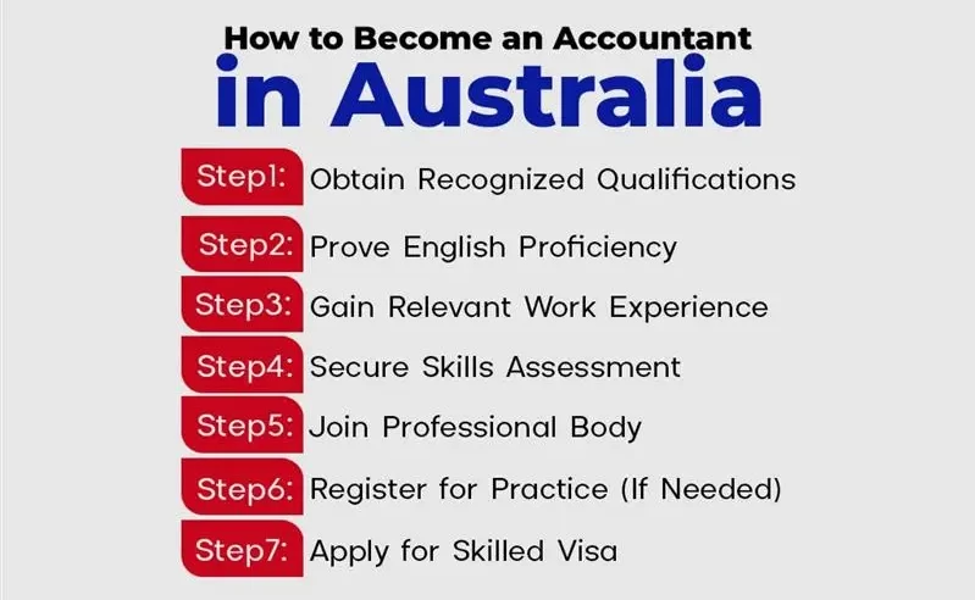
Before applying for a visa or a job, you need to meet a specific set of criteria. Here is what is typically required.
Academic qualifications: A bachelor’s degree or higher in accounting or finance. Your qualification will be assessed against Australian standards by one of the three professional bodies (CPA Australia, CA ANZ, or IPA).
English proficiency: A minimum IELTS score of 7.0 in all four components (listening, reading, writing, speaking) is the standard requirement for both migration and professional membership. The PTE Academic is accepted as an equivalent.
Work experience: Most pathways require one to three years of post-qualification supervised experience. Experience gained in India, the Philippines, the UK, and other common source countries is generally recognised, though the assessing body makes the final determination.
Skills assessment: A positive outcome from the relevant assessing authority is mandatory for most visa types. This is separate from professional membership and must be completed before lodging a visa application.
Professional membership: After migration, joining an Australian professional body involves completing specific modules (typically covering Australian ethics, taxation law, and auditing standards) and meeting ongoing Continuing Professional Development (CPD) requirements.
Step-by-Step Migration Pathway
For international professionals, the process from qualification to Australian employment follows a clear sequence. Skipping or rushing any step creates delays.
Step 1: Skills assessment. Submit your academic transcripts, CV, and professional references to CPA Australia, CA ANZ, or IPA. The body will assess your qualifications against Australian standards and determine whether any bridging study is required. This step can take several weeks to a few months, depending on the body and the completeness of your submission.
Step 2: English language testing. Sit the IELTS or PTE Academic and achieve the required scores across all four components. This must be completed before lodging a visa application.
Step 3: Professional membership enrolment. Begin the process of joining your chosen professional body. Indian Chartered Accountants (CAs), for example, often receive significant exemptions from foundational modules but are still required to complete ethics and Australian law training.
Step 4: Tax registration (if applicable). If you plan to provide tax agent services, register with the Tax Practitioners Board. This step is not required for all accounting roles but is necessary for public practice.
Step 5: Expression of Interest via SkillSelect. Lodge an Expression of Interest (EOI) through Australia’s SkillSelect system. Your profile is scored on a points-based system covering factors including age, qualifications, English proficiency, work experience, and partner skills.
Step 6: Visa application. Based on your EOI and any state or employer interest, you apply for the relevant visa:
- Subclass 189 (Skilled Independent): Points-tested permanent residency with no employer or state sponsor required. Competitive, but the most direct path to PR.
- Subclass 190 (Skilled Nominated): State or territory government nominates you in exchange for a commitment to live and work in that state for at least two years. Adds points to your score and increases invitation likelihood.
- Subclass 491 (Skilled Work Regional): Provisional visa for regional areas, sponsored by a state or an eligible family member. Leads to permanent residency after three years.
- Subclass 482 (Temporary Skill Shortage): Employer-sponsored temporary visa. A common entry point for professionals who secure a job offer before completing the full PR pathway.
Indian CAs: What You Specifically Need to Know
India consistently produces one of the largest cohorts of internationally mobile accountants, and the Australian market has developed specific recognition pathways as a result.
Indian Chartered Accountants (holders of the ICAI CA designation) are generally eligible for significant exemptions when joining CPA Australia or CA ANZ. However, bridging modules in Australian taxation law, Corporations Act compliance, and professional ethics are almost always required regardless of exemption status.
The IELTS requirement is firm. Indian applicants should not assume that English as a medium of instruction in their degree will satisfy the formal testing requirement — it will not. All four bands must meet or exceed 7.0.
Points-based visa scores for Indian applicants are often competitive, particularly for those with postgraduate qualifications, younger age brackets (under 33 attracts maximum age points), and regional sponsorship.
Common Mistakes to Avoid
Starting the visa process before completing the skills assessment. The assessment outcome is a prerequisite for most visa subclasses. Beginning SkillSelect before receiving a positive assessment wastes time and can result in a rejected EOI.
Underestimating English score requirements. A 7.0 in all four IELTS bands is a higher standard than many applicants expect. Preparation time should be factored into your timeline.
Targeting only the Big Four. Mid-tier and regional firms are actively recruiting and often offer faster pathways to senior roles, sponsorship support, and regional visa advantages.
Ignoring the AML/CTF changes effective July 2026. If you plan to work in any client-facing accounting capacity, familiarise yourself with AUSTRAC’s expanded obligations. Firms are already adjusting compliance frameworks, and knowledge of these requirements is a genuine differentiator in the current market.
Overlooking regional options. Metropolitan roles are more competitive and come with higher living costs. Regional roles often process faster, require fewer points for state nomination, and offer meaningful lifestyle and financial trade-offs worth evaluating seriously.
Frequently Asked Questions
Do I need an Australian accounting qualification to work in Australia? No, but you do need a positive skills assessment from one of the three recognised bodies (CPA Australia, CA ANZ, or IPA). They assess your existing qualification against Australian standards and determine whether bridging modules are required. You do not need to repeat your full degree.
How long does the skills assessment take? Processing times vary by body and submission completeness. CPA Australia and CA ANZ typically take four to twelve weeks. Delays are most commonly caused by incomplete documentation — submit a complete application with certified copies of all transcripts and employment references.
Can I get a job offer before completing my migration pathway? Yes, and it can actually simplify the process. A confirmed employer can sponsor you under the Subclass 482 temporary visa, which allows you to begin working while completing the remaining steps toward permanent residency. Many international accountants enter Australia this way.
Is regional Australia a good option for new migrants? For many professionals, yes. Regional roles offer faster visa processing, state nomination advantages, lower competition for positions, and lower living costs. The requirement to live and work regionally for a period is a real commitment, but the trade-off is often worthwhile for the PR pathway advantages it creates.
Will my Indian or overseas work experience count toward Australian requirements? Generally yes. Most assessing bodies recognise overseas post-qualification experience, though it must be documented with employer references and role descriptions that clearly demonstrate relevant accounting work. Experience gained in a different jurisdiction is assessed on its substance, not just its location.
What is the difference between CPA Australia and CA ANZ? Both are highly regarded professional bodies in Australia. CPA Australia issues the CPA designation and is particularly strong in the corporate, commercial, and public sector spaces. CA ANZ issues the Chartered Accountant (CA) designation and has historically been associated with public practice and audit. Both are recognised for migration purposes and by Australian employers. Your choice may be influenced by your existing qualifications, the exemptions on offer, and the sector you want to work in.
How competitive is the Subclass 189 visa for accountants? Invitation scores fluctuate based on the volume of applicants in each occupation. Accounting has historically attracted competitive points thresholds. Applicants with postgraduate qualifications, regional nominations (Subclass 190), and strong English scores are better positioned. Check the most recent SkillSelect invitation rounds for current score benchmarks before building your migration timeline.
Are there age limits for skilled migration to Australia? The points-tested skilled migration programme is open to applicants under 45. Age points are highest for applicants under 33 and decrease incrementally above that threshold. Applicants over 45 are not eligible for the Subclass 189, 190, or 491 pathways, though employer-sponsored options may still be available.
Australia’s accounting shortage is structural, well-documented, and unlikely to resolve quickly. For internationally trained professionals who meet the qualification and language requirements, this is one of the clearest pathways available into a stable, high-paying career with a direct route to permanent residency.
The process has defined steps and known timelines. The demand is genuine. What separates successful applicants from those who stall is preparation — completing the skills assessment before anything else, meeting the English requirement without underestimating it, and approaching the regional versus metropolitan decision with an open mind.
For the right candidate, Australia’s accounting market in 2026 offers both a strong career and a long-term home.