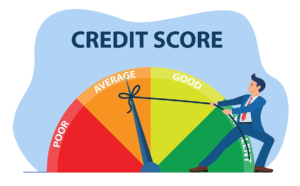
A credit score is a three-digit number, usually somewhere between 300 and 850, that summarizes how risky you look to a lender. It’s built from your credit report, the record of how you’ve borrowed and repaid money over time, and it quietly shapes far more of daily life than most people realize.
It’s not just loans and credit cards. Landlords may check it before approving an apartment application. Utility companies may use it to decide whether you need to pay a deposit. Even some employers check credit history during hiring, though they see a report rather than an actual score.
What Is a Credit Score?
At its core, a credit score is a prediction tool. Scoring models are trained on data from one of the three major credit bureaus, Experian, TransUnion, or Equifax, and many are specifically designed to estimate the likelihood that someone will fall at least 90 days behind on a payment within the next two years.
The number itself doesn’t promise a precise probability. A score of 700 doesn’t mean you have some exact percentage chance of missing a payment. What it does mean is relative: people with a 700 tend to miss payments less often than people with a 600, and more often than people with an 800. Credit scores are best understood as a ranking system, not a fixed prediction.
The FICO Score, created by the Fair Isaac Corporation, is the most widely used model, appearing in roughly 90 percent of lending decisions. VantageScore, developed jointly by the three credit bureaus as an alternative, is the other major model in circulation.
Why Does a Credit Score Matter?
A higher score generally opens doors. It can help you qualify for larger loans and credit limits, lower interest rates, and fewer fees. Over the life of a mortgage or auto loan, the difference between a good score and an excellent one can translate into thousands of dollars in interest.
The effects extend beyond borrowing, too. Cellphone carriers may check credit before approving a device financing plan or a postpaid contract. Landlords often pull credit as part of a rental application. Utility providers sometimes use it to decide whether a new customer needs to put down a deposit.
InsightWire Tip: If you’re renting or opening new utility accounts frequently, keeping your score in good shape can save you from repeated deposit requirements, which add up fast if you move often.
How Is a Credit Score Calculated?
Scoring models weigh several categories of information from your credit report. The exact formulas are proprietary and vary slightly between models, but the FICO Score breaks down roughly as follows:
- Payment history (35%): Whether you’ve paid bills on time, how many payments you’ve missed, and how late those payments were. Bankruptcies and collection accounts fall into this category and carry significant weight.
- Amounts owed (30%): How much you owe overall, and specifically, your credit utilization, the percentage of available revolving credit you’re currently using. A lower utilization rate, ideally under 10 percent, tends to help scores the most.
- Length of credit history (15%): How long you’ve had credit accounts open, including the age of your oldest and newest accounts and the average age across all of them.
- Credit mix (10%): Whether you manage a variety of credit types, such as installment loans (mortgages, auto loans), alongside revolving credit (credit cards).
- New credit (10%): Recent applications for credit, which generate hard inquiries. Too many in a short window can look like financial distress to a lender, even if that’s not the case.
Because payment history and amounts owed together make up 65 percent of the score, they’re the two factors most worth prioritizing if you’re trying to improve your number.
Some information never factors into your score at all, including income, employment status, age, gender, race, nationality, marital status, and religious or political affiliation. Lenders may still ask about income separately on an application, but it won’t appear in the score itself.
Credit Score Ranges: What Counts as Good?
Ranges differ slightly depending on which scoring model is used, and individual lenders can also set their own thresholds for what they consider acceptable. That said, the general FICO ranges are:
| FICO Score Range | Category |
|---|---|
| 800 to 850 | Exceptional |
| 740 to 799 | Very Good |
| 670 to 739 | Good |
| 580 to 669 | Fair |
| 300 to 579 | Poor |
VantageScore uses a similar scale but draws its category lines slightly differently:
| VantageScore Range | Category |
|---|---|
| 781 to 850 | Excellent |
| 661 to 780 | Good |
| 601 to 660 | Fair |
| 500 to 600 | Poor |
| 300 to 499 | Very Poor |
As a general benchmark, a score above 670 on FICO or above 661 on VantageScore is typically viewed favourably by most lenders.
For context, Experian data put the average U.S. credit score at 713 in September 2025, up three points since 2020 but down two points from a year earlier. Economic conditions since 2025, including a cooling labour market, tariffs, government shutdowns, and conflict in the Middle East, have added uncertainty, though average scores remain above pre-pandemic levels.
FICO Score vs. VantageScore: Key Differences
Both models pull from the same underlying credit report data, but they process it differently, which is one reason your FICO and VantageScore numbers can differ even when checked on the same day.
| Factor | FICO Score | VantageScore |
|---|---|---|
| Typical range | 300 to 850 (250 to 900 for industry-specific scores) | 300 to 850 |
| Minimum account age required | Account at least 6 months old with recent activity | No minimum account age required in most cases |
| Hard inquiry window | Considers inquiries from the past 12 months | Considers inquiries from the past 24 months |
| Inquiry grouping | Multiple inquiries within 45 days for the same loan type count as one | Multiple inquiries within 14 days count as one |
| Recent versions | FICO Score 8, 9, 10, and 10T | VantageScore 3, 4, and 4plus |
One practical difference worth noting: VantageScore can generate a score for people with thinner credit files, since it doesn’t require the same minimum account age that FICO does. That makes it more commonly used for consumers who are newer to credit.
InsightWire Tip: If you’re early in building credit and are surprised that one score exists but another doesn’t yet, this is often why. Give it a few more months of activity before assuming something is wrong with your file.
Why You Might See Different Scores
It’s common to check your credit score through different apps or services and see different numbers. This isn’t necessarily an error. FICO alone maintains dozens of scoring models, and it calculates a separate score for each of the three credit bureaus using only that bureau’s data, meaning your “FICO Score” is technically three slightly different numbers depending on which bureau’s report was used. VantageScore, by contrast, produces a single score designed to work consistently across all three bureaus.
Beyond that, some scores incorporate alternative data, such as utility, rent, or streaming payments, while others stick strictly to traditional credit report information. Lenders may also use industry-specific scores built for auto loans or credit cards, or proprietary scores that blend credit bureau data with their own internal customer information.
Common Mistakes That Hurt Credit Scores
Closing unused credit cards. It’s tempting to close cards you no longer use, but doing so can shorten your average account age and reduce your total available credit, both of which can lower your score. It’s often better to keep the account open and simply stop using it, provided you can monitor it periodically for fraud.
Maxing out utilization even while paying in full. Card issuers typically report your balance to the bureaus at the end of your billing cycle, not on your due date. If your statement balance is high when it’s reported, your utilization can look worse than your actual spending habits, even if you pay in full every month.
Applying for too much credit at once. Each new application can trigger a hard inquiry, and while any single inquiry usually costs only a few points, several in a short period can compound and signal risk to lenders.
Ignoring credit report errors. Mistaken late payments or accounts that aren’t actually yours can drag a score down unnecessarily. Reviewing reports regularly catches these before they cause lasting damage.
How to Improve Your Credit Score
Improvement tends to come from consistency rather than any single quick fix.
- Pay bills on time. This is the single most influential factor. It typically takes about six months of consistent on-time payments to see a noticeable shift in your score.
- Pay down revolving balances. Lowering your credit utilization, ideally to under 30 percent and ideally much lower, tends to produce relatively fast improvements.
- Pay early, not just in full. Since balances are often reported before your due date, paying down your balance before the statement closes can lower the utilization figure that actually gets reported.
- Ask for a credit limit increase. This can lower your utilization ratio by increasing your available credit, but only helps if you don’t also increase your spending.
- Bring past-due accounts current. This won’t erase a late payment from your history (most negative marks stay on a report for seven years), but it stops further damage and starts rebuilding trust with lenders.
- Add eligible bill payments to your report. Services like Experian Boost let you add rent, utility, phone, and some streaming payments to your credit file, which can help if you have a strong history of paying those on time.
- Dispute errors. You’re entitled to one free credit report annually from each bureau through AnnualCreditReport.com. If you spot an inaccurate late payment or an account that isn’t yours, you have the right to file a dispute.
InsightWire Tip: Checking your own credit report or score, sometimes called a “soft inquiry,” never affects your score, no matter how often you do it. This is different from a hard inquiry, which occurs when a lender checks your credit as part of a lending decision.
What About Cards You Don’t Use?
Rather than closing unused cards, many financial advisors recommend keeping them open and dormant. That typically means logging into each account to confirm there’s no balance, updating your contact information so you’ll be notified of any suspicious activity, disabling autopay, and setting a reminder to check the account every six months or so. This preserves your available credit and account age without exposing you to ongoing risk from a card you’ve forgotten about.
The Bottom Line
A credit score condenses years of borrowing and repayment behaviour into a single number that lenders, landlords, and sometimes employers use to gauge financial reliability. Understanding what goes into that number, payment history and credit utilization most of all, gives you a clear starting point for improving it. Scores shift gradually rather than overnight, but consistent habits, on-time payments, manageable balances, and periodic review of your credit reports tend to move the number in the right direction over time.