
International candidates face a version of this challenge that domestic applicants largely do not: they must simultaneously manage two rigorous evaluation processes, college admissions and the job market, while navigating immigration timelines, credential translation, and cultural unfamiliarity with U.S. professional norms.
What most candidates do not realize is that the qualities driving success in both arenas overlap significantly. Grades, communication clarity, authenticity, demonstrated commitment, and a coherent personal narrative show up on every evaluator’s checklist, whether the reader is an admissions officer or a hiring manager. Understanding exactly what each group looks for, and what sends them in the other direction, gives any international candidate a meaningful edge.
What Employers Actually Look for in International Candidates
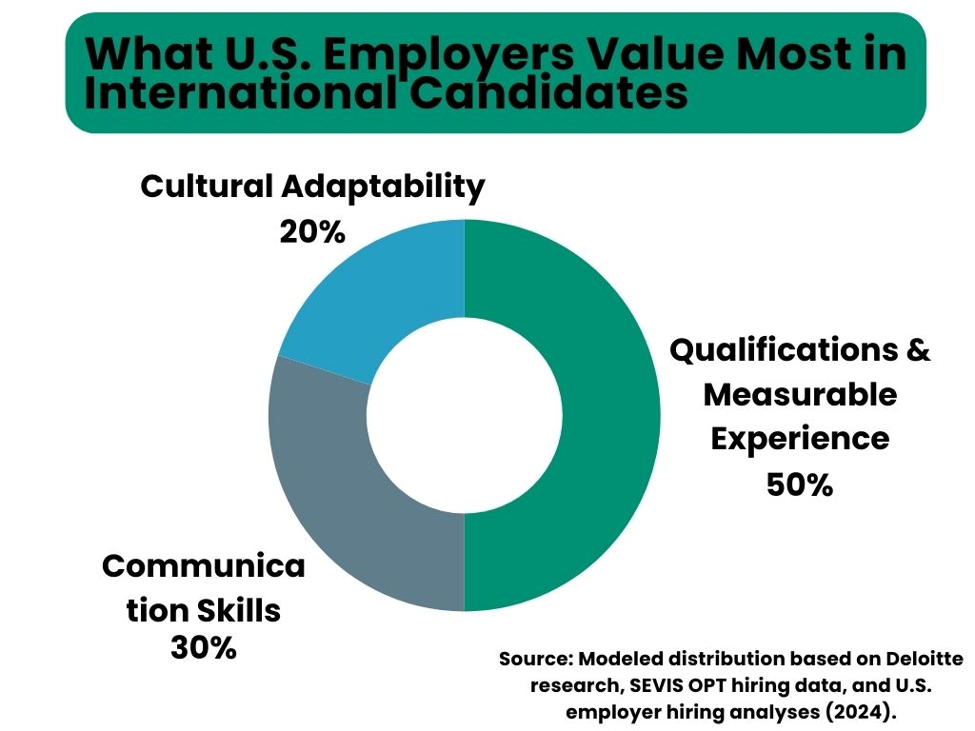
Hiring managers evaluating international candidates consistently focus on three areas. Understanding each one in depth matters more than treating them as a checklist.
Qualifications and Relevant Experience
Academic credentials establish the baseline. Employers verify that your degree level and field of study match the role and that your institution is accredited. But U.S. employers place greater weight on measurable, demonstrable experience than on credentials alone.
What this means in practice: your resume should show what you built, solved, or delivered, not just where you studied and what you studied. Specific accomplishments with quantifiable outcomes, whether a project result, a performance metric, or a problem you resolved, carry more weight than degree titles or certification lists.
Communication Skills
The ability to communicate clearly in the working language, both in writing and verbally, is the most basic threshold that international candidates must meet. This goes beyond grammar. Employers assess how you handle professional interactions: how you present ideas, navigate disagreement, build rapport, and structure written communication.
A common and costly mistake international candidates make is writing cover letters that are too formal, too lengthy, or too indirect by U.S. standards. American professional culture values concise, confident, direct communication. A cover letter that buries the point in three paragraphs of context will not perform as well as one that leads with the value you offer.
Cultural Adaptability
Employers are not simply checking a diversity box when they hire internationally. They are looking for candidates who bring a genuine global perspective: demonstrated experience working across cultures, the ability to adapt communication and work style to different contexts, and a track record of approaching problems from unfamiliar angles.
Research from Deloitte indicates that diverse thinking drives innovation by approximately 20%. The practical implication for candidates is that cultural adaptability is not a soft bonus on your profile. It is a concrete differentiator that belongs in your resume, cover letter, and interview answers with specific examples behind it.
Which Companies Hire the Most International Candidates
The largest employers of international students in the United States are concentrated in technology and STEM-adjacent fields. According to data from the Student and Exchange Visitor Information System (SEVIS), managed by U.S. Immigration and Customs Enforcement, Amazon led all U.S. employers in 2024 with 6,679 new OPT hires. Google followed with 1,778, Microsoft with 1,496, and Meta with 1,302.
The full SEVIS top 10 also includes the University of California, Walmart, Intel, Apple, Goldman Sachs, and Tesla. Outside the technology sector, finance and consulting firms, including Deloitte, McKinsey, EY, and JP Morgan, are consistent OPT and H-1B sponsors.
Why OPT Has Become More Important
As H-1B processes have grown more competitive and unpredictable, companies are increasingly using Optional Practical Training (OPT) as an earlier entry point into their international talent pipeline. For candidates seeking long-term U.S. employment, Fortune 500 companies with established OPT hiring programs represent the clearest path toward H-1B sponsorship and permanent employment authorization.
Understanding how visa sponsorship works before you begin applying gives you a significant strategic advantage. A thorough breakdown of how visa sponsorship works and how to secure one is worth reading before you start targeting employers.
The STEM Advantage
STEM candidates hold a structural advantage in this environment. The STEM OPT extension allows up to 36 months of work authorization, compared to 12 months for non-STEM graduates. That extended runway gives employers significantly more time to support a candidate through the H-1B sponsorship process, making STEM candidates a lower-risk hire from an immigration logistics standpoint.
Non-STEM candidates face more compressed timelines and higher competition. The practical response is to specifically target employers with active, documented international hiring programs rather than applying broadly and hoping for sponsorship conversations to arise later.
What Admissions Officers Look for in International Applicants
What Gets Reviewed First
Contrary to what many applicants assume, admissions officers at selective U.S. institutions start with grades, not test scores. GPA and course rigour are the most heavily weighted factors in the initial review. Officers examine grade trends across all four years of secondary school, the level of academic challenge reflected in the curriculum (AP, IB, honours courses), and whether the student took the most rigorous courses available to them at their school.
For international candidates, transcripts are read in the context of the home country’s grading system. Admissions officers at selective institutions are trained to evaluate international transcripts and understand country-specific grading conventions. You do not need to convert your grades to the U.S. GPA scale on the Common Application. Report them as-is.
If your transcript is not in English, it will require either a certified translation or evaluation by a recognized third-party service. World Education Services (WES) is widely accepted by U.S. institutions for this purpose.
English proficiency scores, whether TOEFL, IELTS, or Duolingo English Test, are reviewed alongside the academic record. These assessments are not about achieving a perfect score. They confirm that a candidate can study and communicate effectively in English at the university level.
The Three Things That Make an Application Compelling
Defined, sustained interests: Admissions offices are not trying to build classes of well-rounded students. They are building well-rounded classes out of specialists. A student with two to three years of meaningful, consistent involvement in a focused area is a stronger candidate than one who lists ten unrelated activities they joined superficially.
Officers are experienced at reading activity lists and spotting padding. Sustained engagement in a chosen area, particularly if it aligns with the intended major and is reflected in the personal essay, signals the kind of focused commitment that admissions teams are looking for.
Strong grades in rigorous courses: Good grades in easy courses are not impressive. Officers look for candidates who challenged themselves relative to what was available at their school. A B in the most rigorous available curriculum is often viewed more favourably than an A in a less demanding one.
Context and authenticity in the personal essay: The personal statement’s job is to show who you are through specific, honest anecdotes, not to list accomplishments that are already in your activity section or transcript. Columbia’s admissions office has described the essay review process as an effort to understand a candidate’s perspective and engagement with the world. The goal is a reader coming away with a clear sense of who this person is, not a summary of what they have done.
Do Admissions Officers Read Every Activity Listed?
Yes. Every listed activity receives attention, but quantity is not the goal and can actively work against you. Ten superficial, unconnected activities across different fields tell a less compelling story than three years of consistent leadership in one or two focused areas that align with the candidate’s stated major and essay narrative.
Padded activity lists are a recognized red flag for officers at selective institutions. Unrelated, brief, or clearly performative entries are easy to identify after reading thousands of applications, and they raise questions about authenticity that carry into the rest of the review.
Demonstrating Genuine Interest in Specific Institutions
For international candidates competing for a limited number of available international spots, demonstrated interest in a specific institution can be a meaningful differentiator. This means more than submitting a strong application. It includes engaging with the admissions office, attending virtual information sessions, contacting international student services, and writing supplemental essays that reference specific programs, faculty, or campus resources by name.
Many U.S. colleges now track demonstrated interest as part of the formal review process. Generic supplemental essays, or ones that describe programs the institution does not actually offer, are among the fastest ways to signal low effort to an officer who reads thousands of applications per cycle.
Red Flags in College Applications: What to Avoid
Admissions officers at selective institutions are pattern-recognition specialists. These are the signals that consistently raise concerns:
Unexplained grade inconsistency: A sudden drop in grades without context raises immediate questions about academic readiness or integrity. If there is a legitimate reason, illness, a family crisis, a school disruption, it belongs in the additional information section of the application. Leaving it unaddressed invites the reader to fill in the gap negatively.
Mismatch between stated major and actual profile: Applying to a computer science program with no STEM coursework, activities, or essay content referencing technology is immediately visible. The intended major, activity list, course selections, and essay need to form a coherent, mutually reinforcing narrative. Inconsistency between what a candidate claims to want and what their profile actually reflects is a significant red flag.
Essays that do not sound like the applicant: Admissions counsellors read tens of thousands of essays over a career. A polished essay paired with modest English proficiency scores creates an obvious inconsistency. Authenticity and a genuine voice matter more than stylistic perfection. An imperfect essay that clearly belongs to the student is stronger than a technically impressive one that does not.
Exaggeration and inflated claims: Overstating the scale of a charity project, the size of an audience reached, or the scope of a leadership role tends to backfire. Specific, honest descriptions of what you actually did and what impact it had are more credible and more persuasive than vague claims of exceptional achievement.
Generic or misdirected supplemental essays: Writing the wrong school name, or describing programs the institution does not offer, signals that the essay was not written specifically for that school. Each supplemental response should demonstrate genuine research into the specific institution, referencing real programs, faculty, research centers, or campus resources.
Problematic public social media: Some admissions officers check public profiles. Content that contradicts the character presented in an application, or that reflects poor judgment, has resulted in withdrawn offers. Review your public-facing profiles before submitting applications.
What actually impresses: A consistent narrative across all application components. Intellectual curiosity with specific evidence behind it. Focused leadership in a chosen area over time. An authentic personal essay that demonstrates self-awareness. Letters of recommendation that add genuine context rather than restating what is already in the transcript.
How to Perform Well in Admissions Interviews
The interview is an opportunity to add dimension to your application, not to repeat your resume. Admissions officers use interviews to assess maturity, self-awareness, and genuine institutional interest.
What works:
- Specific, informed knowledge of the school’s programs, including faculty you want to work with or research areas you want to pursue
- Honest reflection on past challenges and what you learned
- Clear articulation of academic and professional goals
- Thoughtful questions for the interviewer that demonstrate genuine curiosity
What raises flags:
- Rehearsed or memorized answers that feel scripted
- Vague enthusiasm for a school without specific knowledge of what makes it distinctive
- Inability to hold a focused, clear conversation
After the interview, send a brief thank-you email within 24 hours. It is a small signal of professionalism and follow-through that a meaningful number of candidates skip.
Organizational Red Flags That Push Strong International Candidates Away
Hiring is a two-way evaluation. International candidates, who are often managing competing offers alongside hard visa authorization deadlines, are more attuned to employer warning signs than domestic candidates. Employers who want to attract strong international talent need to understand what they are signalling.
Research from Harvard Business Review identifies four organizational behaviors that deter strong candidates: unclear information about the role or organization, poor recruitment practices, disengaged interviewers, and a weak or negative corporate reputation. International candidates add several specific concerns to that list:
Vague job descriptions: If a role cannot be described clearly, international candidates cannot assess OPT eligibility or confirm that their work authorization covers the actual duties. Ambiguity at the job description stage reads as organizational disorganization, not mystery.
No visible sponsorship history: Candidates can and do research employer visa sponsorship history through USCIS databases and tools like MyVisaJobs before applying. An employer with no track record of sponsoring international workers is not an abstract concern. It is a practical barrier that candidates will identify and filter out early.
High staff turnover: Frequent re-postings for the same role are a recognized red flag across all candidate types. For international candidates already carrying immigration risk, a company that cannot retain staff signals instability that compounds rather than offsets that risk.
Slow or absent communication: For a domestic candidate, delayed communication from an employer is frustrating. For an international candidate managing OPT application deadlines or H-1B lottery timelines, it can be disqualifying. Employers who communicate poorly through the hiring process signal that they will communicate poorly afterwards.
Pressure tactics and exploding offers: Demands for unrealistically quick decisions are disproportionately harmful to international candidates who need time to verify work authorization, consult with their international student office, and compare the visa sponsorship implications of multiple offers. Pressure tactics in the offer stage are a reliable signal of how the employer operates generally.
If you are still evaluating where to focus your international career search, exploring the top countries to work abroad in 2026 may help broaden your options beyond the U.S. job market.
What College Admissions and Employer Selection Have in Common
The overlap between what admissions officers and hiring managers look for is not coincidental. Both groups are making high-stakes decisions about people they cannot fully know from a document, and both have developed similar heuristics for managing that uncertainty.
Both processes reward: consistency between what a candidate claims and what their profile demonstrates, communication that is direct and clear, evidence of genuine commitment in a focused area over time, and the maturity to present themselves honestly rather than strategically.
For international candidates, success in both arenas starts with the same foundation: understanding what evaluators actually read, what raises concerns before they reach your strongest material, and building a profile that holds up under scrutiny at every layer.
Important Point to Takeaway
- Employers evaluate international candidates on qualifications, communication clarity, and demonstrated cultural adaptability. Each of these requires specific examples, not general claims.
- Amazon led all U.S. employers in 2024 with 6,679 new OPT hires. The top hiring companies are concentrated in technology, finance, and consulting.
- STEM graduates qualify for up to 36 months of OPT work authorization, giving them a structural hiring advantage over non-STEM graduates who face a 12-month window.
- Admissions officers review grades and course rigor first, ahead of test scores. Strong performance in a rigorous curriculum is the most important element of any application.
- A focused profile with deep commitment in two to three areas is more compelling than a broad, superficial list of activities. Padding is a recognized red flag.
- Authenticity and a genuine voice in the personal essay outperform polished but inauthentic writing, particularly when paired with English proficiency scores.
- International candidates evaluate employers just as rigorously as employers evaluate candidates. Vague job descriptions, no sponsorship history, and poor communication are all practical barriers that strong candidates act on.
- The qualities that drive success in admissions and hiring overlap significantly: consistency, clear communication, focused commitment, and honest self-presentation.
Frequently Asked Questions
Do U.S. employers sponsor international candidates for H-1B visas?
Yes, but not all of them do, and the process has become more competitive. Large technology companies, finance firms, and consulting practices are the most consistent sponsors. You can research an employer’s H-1B sponsorship history through USCIS public data and tools like MyVisaJobs before investing significant time in an application.
What is OPT, and how long does it last?
Optional Practical Training (OPT) is a work authorization program that allows international students who have studied in the U.S. on an F-1 visa to work in their field for a defined period after graduation. Standard OPT provides 12 months of authorization. Graduates in STEM fields qualify for a 24-month extension, allowing up to 36 months of work authorization in total.
Do I need to convert my international grades to the U.S. GPA scale on the Common Application?
No. Report your grades in the format used by your home country’s system. Admissions officers at selective U.S. institutions are trained to read and contextualise international transcripts. If your transcript is not in English, you will need a certified translation or third-party evaluation from a service such as World Education Services (WES).
Which English proficiency test do U.S. universities accept?
Most U.S. universities accept the TOEFL, IELTS, and Duolingo English Test. Requirements vary by institution, and some programs have minimum score thresholds. Check the specific requirements of each institution you are applying to rather than assuming a single standard applies everywhere.
How important are test scores (SAT/ACT) compared to grades for international applicants?
Less important than grades. Admissions officers start with academic performance, meaning GPA and course rigour, before reaching test scores. Many institutions have moved to test-optional policies in recent years, but a strong academic record with rigorous coursework remains the most important element of any application.
Can I apply to U.S. universities without an admissions interview?
Many U.S. universities offer optional or alumni interviews rather than requiring them. Where offered, international candidates should generally accept. The interview is an opportunity to add context and personality to an application that may otherwise lack the in-person touchpoints domestic applicants have, such as campus visits and in-person information sessions.
What is demonstrated interest, and does it affect international admissions?
Demonstrated interest refers to the behaviours that signal genuine, specific interest in a particular institution, including attending virtual events, contacting admissions or international student services, and writing supplemental essays that reference specific programs or faculty. Many U.S. institutions track demonstrated interest formally. For international candidates competing for a limited number of international spots, it can be a meaningful differentiator.
Should I address a low grade or academic gap in my application?
Yes, if there is a legitimate explanation. The additional information section of the Common Application exists for exactly this purpose. Admissions officers reading an unexplained grade drop will fill in the gap on their own, often less charitably than the truth warrants. A brief, honest explanation is almost always better than leaving the question open.
How do I know if an employer is genuinely open to hiring international candidates?
Look for employers that have an established OPT hiring history, appear in SEVIS employer data, and explicitly mention work authorization support in their job postings. Vague job descriptions, no visible sponsorship history, and slow communication during the hiring process are practical signals that an employer is not set up to hire internationally, regardless of what their careers page says.
What is the biggest mistake international candidates make in job applications?
Writing cover letters and resume summaries that are too formal, too lengthy, or too indirect for U.S. professional norms. American employers expect concise, confident, direct communication that leads with the value you offer. Burying your strongest points in context or preamble, or defaulting to the formal tone of your home country’s professional writing conventions, reduces the impact of your application significantly.
To summarize
International candidates who succeed in both the admissions process and the job market tend to share one quality: they understand what they are being evaluated on before they build their application or their resume. That knowledge changes how they present their experience, which activities they invest in, which employers they target, and how they communicate throughout every stage of the process.
The criteria are demanding but consistent. Evaluators on both sides of the table are looking for the same thing: a candidate whose profile holds up under scrutiny, whose communication is clear and direct, and whose commitment to a focused area is evidenced rather than simply claimed. For international candidates willing to invest in understanding those criteria deeply, the path forward is clearer than it may initially appear.