
Foldable smartphones have had a strange few years. The technology works. The hardware has matured. Samsung, Huawei, Motorola, and Google have each released compelling devices. And yet, the category stubbornly refuses to go mainstream.
As of early 2026, foldables still account for only 1 to 3% of total global smartphone shipments, a number that has barely moved despite years of iteration and falling prices. A new study published in May 2026 by SmartTech Research offers a clear explanation for why: consumers are not rejecting foldables. They are waiting for Apple.
That wait may be nearly over. Apple is widely expected to unveil its first foldable iPhone, likely called the iPhone Fold or iPhone Ultra, at its fall 2026 event alongside the iPhone 18 Pro lineup. And if the consumer sentiment data is accurate, that single product announcement could do more to shift the foldable market than six years of combined Android releases.
Why Foldables Have Stalled Despite Good Hardware
The foldable category is not lacking for innovation. Samsung’s Galaxy Z Fold 7 generates roughly the equivalent revenue of 15 entry-level handsets at list price, and foldables contributed more than 20% of volume within Samsung’s premium tier despite being a small fraction of overall shipments. The economics of selling foldables are compelling for manufacturers. The consumer adoption story is a different matter.
Global foldable smartphone shipments in Q1 2026 came in at 3.1 million units despite an overall 14% decline in the broader smartphone market. The market is growing in pockets, but has not cracked into mass-market territory. Three companies control the vast majority of the space: Huawei leads with 40% market share, Samsung holds 25% after a strong performance driven by Galaxy Z Fold 7 and Z Flip 7 promotions, and HONOR holds 19%.
The reasons behind sluggish consumer adoption are structural. Screen creases remain a visible irritant. Repair costs for folding displays are steep. Early models earned a reputation for fragility that has been slow to shake, even as durability has meaningfully improved. And the price of entry has historically put foldables firmly in luxury territory, competing not just with other phones but with laptops and tablets.
None of these obstacles have disappeared. But they matter far less when the company making the device is one consumers already trust implicitly with their most personal device.
What the Consumer Research Actually Found
The May 2026 SmartTech Research study surveyed 531 everyday consumers across the United States, deliberately selecting respondents who represent typical buyers rather than tech enthusiasts. The findings are significant.
More than 58% of respondents expressed openness to buying a foldable phone. That is a striking number for a category with a sub-3% market penetration, and it suggests the awareness-to-adoption gap is unusually wide.
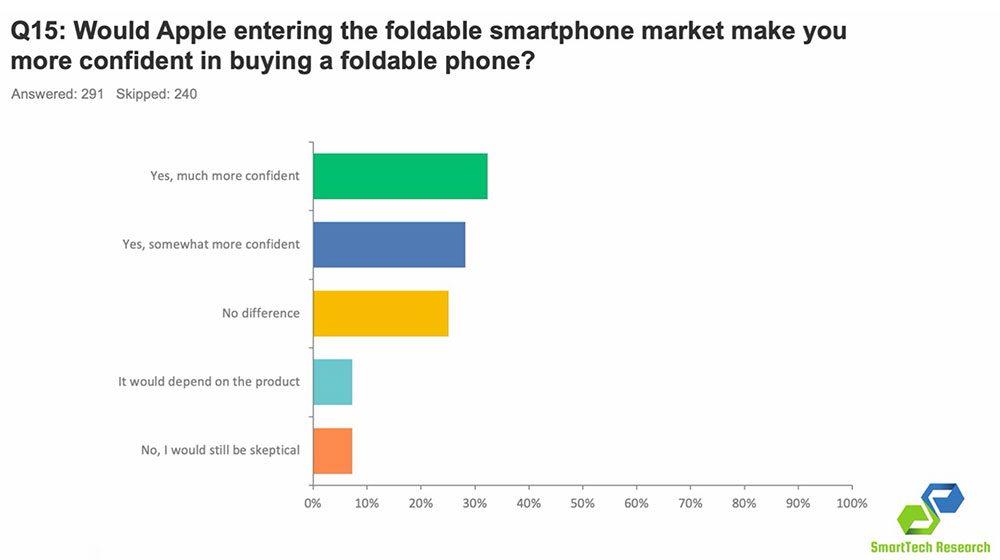
The more important finding: 60.5% of consumers said they would feel more confident buying a foldable phone if Apple made it. This is the Apple halo effect in measurable form. For a meaningful portion of the smartphone-buying public, the question is not “do I want a foldable?” but “do I trust the company making it enough to pay a premium and accept the trade-offs?”
Nearly a third of respondents said they are explicitly waiting for Apple before they will even consider a foldable device. This is the clearest sign yet that a large pool of latent demand exists, parked and waiting for the right product.
What Buyers Actually Want From a Foldable
The study is also useful for cutting through assumptions about what consumers find compelling. The reasons driving foldable interest are not futuristic or exotic:
- 39.9% want a larger display for watching videos, reading, and browsing
- 19.6% want the ability to run apps side by side without switching between them
- 15.8% want a tablet-sized screen that still fits in a pocket
These are practical, daily-use motivations. A foldable iPhone positioned correctly could serve as the missing link between a standard iPhone and the iPad mini: one device that does both jobs without the user carrying two screens.
The activities driving interest reinforce this. Entertainment, multitasking, and reading are the three core use cases, not niche professional workflows or specialist applications. Apple would be entering foldables with a ready-made audience that already knows exactly what it wants.
The iPhone Fold: What Leaks and Analysts Are Saying
Apple has not confirmed anything publicly, but the evidence from supply chain reporting, analyst forecasts, and iOS code is now substantial enough to paint a fairly detailed picture of what is coming.
Design and form factor:
Every credible leak describes the device as a book-style foldable, the same general shape as Samsung’s Galaxy Z Fold, not a clamshell flip. Dummy models and leaked renders show a wide, passport-style design with a 7.76-inch inner display at 2,713 x 1,920 resolution and a 5.49-inch outer display at 2,088 x 1,422 resolution.
The crease problem:
Apple has reportedly prioritized solving the crease issue that has defined every book-style foldable to date. Reports describe the crease as “nearly invisible” when unfolded, with Apple pursuing its elimination “regardless of cost,” developing a new material property specifically to address this. Samsung Display has reportedly secured a three-year exclusive deal to supply the foldable OLED panel and briefly demonstrated a crease-free panel at CES 2026.
Chip and specs:
The device is expected to use Apple’s A20 Pro chip on TSMC’s 2nm process, shared with the iPhone 18 Pro, with 12GB of RAM stacked directly onto the chip using WMCM packaging.
Camera trade-offs:
The foldable iPhone will have two rear cameras rather than three, with a Wide and Ultra Wide lens but no Telephoto, because there is simply not enough room for it given the thin chassis design. The device is also expected to use Touch ID via a power button rather than Face ID.
Software signals:
iOS 27 code includes references to “foldState” and “angleDegrees,” pointing directly to foldable functionality under active development. A new multitasking capability is also reportedly in the works for iOS 27, similar to Huawei’s Parallel View, allowing a single app to display in two simultaneous parallel windows.
Launch timing:
Apple is targeting a fall 2026 launch alongside the iPhone 18 Pro and Pro Max, though a supply chain report from DigiTimes pushed mass production back from June to August, compressing the runway between first units off the line and units in consumer hands. Supply shortages into early 2027 are possible, with analyst Ming-Chi Kuo flagging potential availability constraints at launch.
The Pricing Problem: Where Apple Faces Its Toughest Test
This is where the consumer survey delivers its most uncomfortable finding for Apple.
The study reveals that 70% of buyers expect to pay less than $1,000 for their next phone. Only 5.1% of respondents plan to spend more than $1,500. Yet every credible analyst estimate for the foldable iPhone places it well above that ceiling.
The most recent reports point to a starting price of $1,999, down from earlier 2025 estimates of $2,399, with higher storage options likely adding $200 increments, placing a 512GB version at approximately $2,199 and a 1TB model at $2,399.
Here is the pricing breakdown the survey revealed for maximum acceptable spend on a premium foldable:
| Maximum Acceptable Price | Share of Respondents |
|---|---|
| Under $1,500 | 38.1% |
| $1,500 to $1,799 | 18.2% |
| $1,800 to $1,999 | 9.3% |
| $2,000 to $2,199 | 11.0% |
| $2,800 or more | 2.8% |
Even with Apple’s brand trust and ecosystem advantage, a $1,999 starting price places this product beyond the comfortable range of the overwhelming majority of respondents. The foldable iPhone will not be a mass-market product on day one, and the survey data makes that clear.
This creates a tension Apple will need to manage carefully. The company’s entry into this category is likely to expand the overall foldable market dramatically, regardless of whether the price is approachable. IDC projects that Apple will capture over 22% of foldable unit share and approximately 34% of total foldable market revenue in its first year, primarily due to its expected premium pricing. That is an extraordinary debut, but it means Apple will initially own the revenue side of the market rather than the volume side.
Why Apple’s Entry Changes Everything for the Category
Apple does not need to sell a foldable iPhone in the tens of millions to reshape the market. It needs to demonstrate that foldable smartphones can be reliably engineered, smoothly integrated into a software ecosystem, and worth the premium. That alone removes the primary objection that has kept cautious buyers on the sidelines.
The ecosystem lock-in point from the SmartTech Research study deserves particular attention. For iPhone users, switching to an Android foldable means giving up iMessage, FaceTime, Apple Pay, iCloud continuity across Mac and iPad, and the seamless device handoff features that iOS users rely on daily. Nearly a third of consumers in the survey said they are waiting specifically for Apple rather than simply waiting for a better foldable. That is not a preference for a design; it is a preference for a platform they are already embedded in.
IDC’s Francisco Jeronimo put it directly: “The launch of Apple’s first foldable iPhone will mark a turning point for the foldable segment. This move is likely to boost category awareness and drive consumer interest. Apple tends to be a catalyst for mainstream adoption of new categories.”
IDC forecasts the foldable market to grow 30% year over year in 2026, driven in large part by Apple’s anticipated entry, compared to just 6% growth in the prior forecast period. Android manufacturers are already responding: Samsung is introducing the Galaxy Z Trifold to anchor the ultra-premium tier, and Huawei is planning to nearly double its foldable shipments ahead of Apple’s arrival.
What This Means If You Are Thinking About Buying One
The foldable iPhone will not be for everyone, particularly at launch. Here is a practical guide for different types of buyers:
Buy it if:
- You are a longtime iPhone user who genuinely wants a larger screen but does not want to carry both an iPhone and an iPad
- You work in a role where multitasking on a single device has real productivity value
- You are comfortable being an early adopter of first-generation Apple hardware and have the budget to match
Wait if:
- You primarily want a foldable for casual entertainment and basic use; a standard iPhone 18 Pro will handle that better at a lower price
- You are sensitive to supply constraints; early availability is expected to be tight, possibly running into 2027
- You want to see independent durability testing on the hinge and display before committing
Consider alternatives if:
- Your budget is firmly under $1,500; Samsung’s Galaxy Z Fold and Z Flip lines offer proven hardware at more accessible price points, and Motorola has been pushing foldables below $1,000
- You have already left the Apple ecosystem and are comfortable on Android
The foldable smartphone market has had the technology for years. What it has been missing is a catalyst powerful enough to pull everyday consumers past their hesitation, and consumer research now makes it clear that Apple is that catalyst for a substantial portion of the market.
Whether the foldable iPhone succeeds on its own terms, as a durable, crease-free, iOS-native device that justifies a $2,000 price point, is a question that will be answered in reviews and return rates, not in leak reports. But its effect on the broader category will happen regardless of how the product is received. Competitors are already responding, software developers are already building for flexible displays, and carriers are already thinking about how to position foldable trade-in programs.
The waiting period for foldables is ending. The question now is what Apple has actually built.
Frequently Asked Questions
What will the foldable iPhone be called? Apple has not announced an official name. The most widely used industry reference is “iPhone Fold,” but recent leaks and analyst reports suggest Apple may call it “iPhone Ultra,” aligning with its existing Ultra branding on Apple Watch and M-series chips. You may also see “iPhone Ultra Fold” used informally. The actual name will be confirmed at Apple’s fall event.
When will it be available to buy? Apple is targeting a fall 2026 launch, most likely alongside the iPhone 18 Pro and Pro Max in September. Manufacturing delays could push some availability into October or later. Supply shortages at launch are widely expected, so early pre-order placement will likely matter.
How much will it cost? Based on current analyst estimates, the starting price is expected to be around $1,999 for a base configuration. Higher storage tiers could push the price to $2,199 or $2,399. This will make it the most expensive iPhone Apple has ever sold.
Will it run all my existing iPhone apps? Yes. iOS 27 is being developed with foldable support built in, and Apple will almost certainly provide developer tools for optimizing apps to take advantage of the larger inner display. Most apps will work on day one, though some may not be optimized for the larger screen format immediately.
Will it have Face ID? No. Due to the thinner chassis required by the foldable design, there is reportedly no room for the TrueDepth camera system. The device is expected to use Touch ID via a power button, similar to iPads that lack Face ID.
Is this a good time to buy a competing Android foldable, or should I wait? If you are an Android user happy in that ecosystem, current options from Samsung and Motorola are excellent. If you are an iPhone user considering a foldable, waiting for Apple’s entry makes practical sense given the ecosystem continuity benefits.
How durable will the hinge and screen be? Apple has reportedly invested significant resources into hinge engineering and display materials specifically to address the durability concerns that have followed other foldables. Independent testing after launch will be the real measure, but Apple’s stated priority is delivering a product that feels like a polished iPhone from day one rather than a prototype.
What is the battery life likely to be? No reliable battery capacity figures have leaked yet. The thin chassis design typically creates trade-offs on battery size. Apple’s performance-per-watt advantage with its A-series chips may help offset this, but battery life will likely be a key area of scrutiny in early reviews.